Kling 4.0 for Product Videos: What's New for B2B Teams
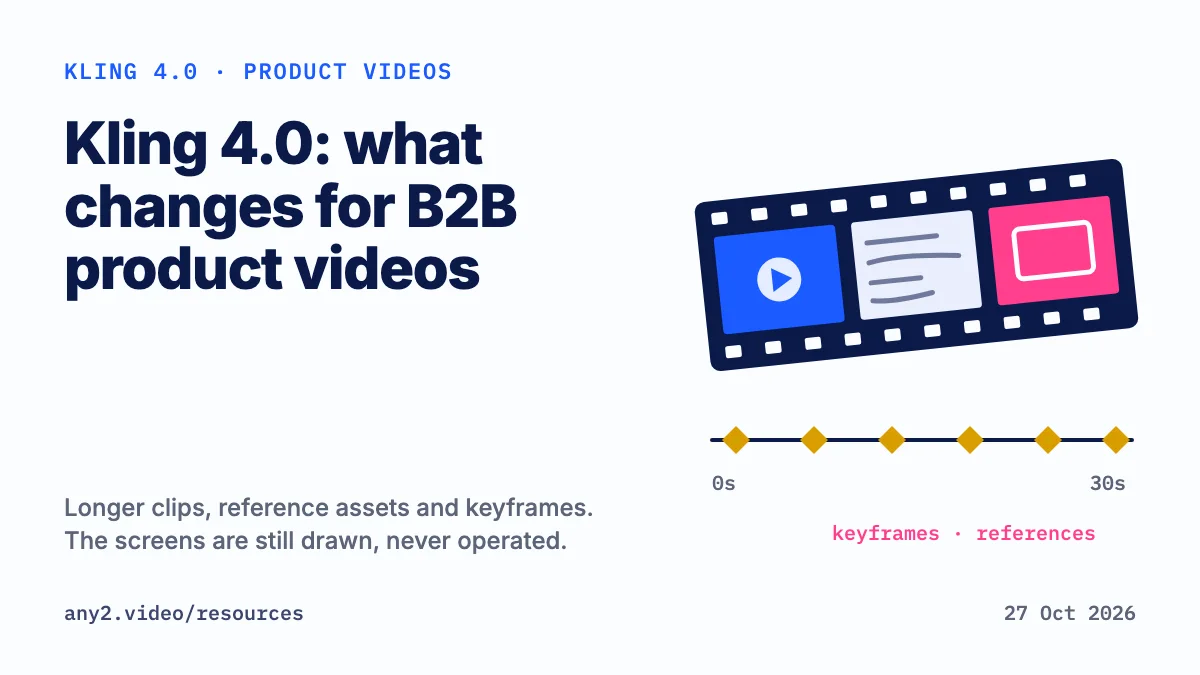
Kling 4.0 brings 30-second clips, up to 15 reference assets and 10 keyframes, per Kling. Some of that has shipped and some is still listed as coming soon. Here is what it changes for a B2B product video, and what it still cannot show.
Kling 4.0 is the new video model from Kling AI, the video unit of Kuaishou, launched worldwide in mid-October 2026. For B2B product videos, three changes matter, per Kling: single clips up to 30 seconds, up to 15 reference assets to keep a brand consistent, and up to 10 keyframes to plan a shot. What it still cannot do is show your real product working, because it never runs it.
When Kling 4.0 launched, and where the dates disagree
Kling AI announced Kling 4.0 on 28 September 2026 and opened early access to Kling 4.0 Flash the same day, according to Nereo's release guide (updated 24 October 2026). SandBase's launch write-up of 23 October 2026 says that early access went to Ultra Yearly subscribers.
The full launch date depends on which source you read. SandBase and Atlas Cloud give 15 October 2026. Kling's press release, distributed by GlobeNewswire, carries a Beijing dateline of 16 October 2026, and SandBase treats it as a press release issued the day after the launch. Nereo's guide says no exact day was published.
What Kling says the model does
The press release lists native 30-second generation, up to 15 reference assets and 10 keyframe inputs through a feature Kling calls Omni Reference, prompts of up to 8,000 tokens, and the option to upload an existing video and extend it to two minutes. References can be images, video or audio. The release says the model is fully available on the Kling AI website, lists 10-bit HDR at 4K and 1080p and a 21:9 ultrawide format as coming soon, and says enterprise and developer API access will follow soon, with no date.
Nereo describes the audio as two-channel stereo with tighter lip sync. SandBase found that the API always adds a stereo track and has no switch to turn it off. The press release also lists wider language and accent support, naming English, Japanese, Korean, Spanish, Portuguese, German, French and Hindi, and American, British and Indian English accents.
What has shipped so far
The third-party write-ups, all from the last week, give a mixed picture:
- API: SandBase reports that the Kling 4.0 API launched on 21 October 2026 with gradual global access. Nereo says Kling 4.0 has been live on its own platform since 22 October 2026.
- Keyframes and references in the API: in SandBase's tests on 23 October 2026, the API accepted a start frame and an optional end frame, plus up to 10 images and 5 videos as references. The 10-keyframe control in the press release was not in the API they tested.
- HDR and 4K: SandBase found no HDR option and 8-bit files, with 720p and 1080p available and 4K not. Nereo lists HDR as coming soon and current output as SDR.
- Two-minute extension: Nereo lists it as coming soon, and SandBase could not confirm it had shipped.
- Flash: Nereo gives Kling 4.0 Flash a range of 3 to 20 seconds at 720p. Atlas Cloud, writing on 26 October 2026, advises trusting the duration selector in Flash over the 30-second figure, and says it does not offer a runnable Kling 4.0 Flash endpoint itself.
Before you plan a project around one feature, check that it appears on the Kling creation page or in the API you will use.
What Kling 4.0 changes for B2B product videos
For a software or hardware company, the useful changes are in the parts of a video that were never about the product screen:
- Longer shots. Kling 3.0 stopped at 15 seconds per generation, according to Nereo. A 30-second single pass covers a full opening or a problem setup without stitching clips together.
- Brand consistency. Up to 15 references means you can give the model your logo, product photos, a hardware unit from several angles and a colour reference in one request. Atlas Cloud still reports subject drift and recommends one clean start image plus a written list of details that must not change.
- Shot planning. Keyframes set where a shot starts and where it ends, which helps when the clip has to cut into a recorded segment. In the API SandBase tested, that meant a start frame and an end frame.
- Language versions. The wider language and accent list makes it easier to regenerate an opening for a second market.
What it still cannot do for a product walkthrough
Kling 4.0 builds a clip from references and a prompt. It has no login to your product, no access to the version you just released and no way to check that a setting it shows exists. A screenshot used as a reference or a keyframe gives it a starting picture of your interface, and every frame after that is generated, so menu names, field labels and numbers can shift in ways a buyer who knows the product will see.
Atlas Cloud's testing notes point the same way for text: it says generated lettering can fail even when the rest of the shot is usable, and that on-screen text is not a reliable test of success. In a walkthrough, the on-screen text carries the content: the menu path, the error message, the version number. A 30-second clip also gives the model more interface to draw, and you more frames to check.
Where any2.video fits
any2.video makes verified product walkthroughs. An operator runs a real task on the real product, on a stated version, checks the result against evidence the product produced and keeps the failed attempts in the record. Delivery takes about two days, and the first sample, one product and one task, is free.
The two can share a video. Generate the opening with Kling 4.0 if it suits your brand, label it as generated, and record the part that has to prove the product works. AI video generators for product marketing covers the same limit for other generators, and what a verified walkthrough proves lists the questions to ask any vendor, us included.
Questions about Kling 4.0
When was Kling 4.0 released?
Kling AI announced Kling 4.0 on 28 September 2026, with early access to Kling 4.0 Flash for some annual subscribers, according to Nereo. SandBase and Atlas Cloud date the full launch to 15 October 2026; Kling's press release is dated 16 October 2026.
How long can a Kling 4.0 video be?
Up to 30 seconds in one generation, according to Kling's press release, and SandBase produced a 30-second clip through the API. Nereo lists Kling 4.0 Flash at 3 to 20 seconds. Extending an uploaded video to two minutes is in the press release, and Nereo lists it as coming soon.
Is the Kling 4.0 API available?
The press release said API access would come soon. SandBase reports that the API launched on 21 October 2026 with gradual global access, and Nereo says it has offered Kling 4.0 since 22 October 2026. SandBase found the API took a start and end frame rather than 10 keyframes.
Does Kling 4.0 support 4K and HDR?
The press release lists 10-bit HDR at 4K and 1080p as coming soon. In SandBase's API tests on 23 October 2026, output was 8-bit at 720p or 1080p, with no 4K. Nereo lists current output as SDR.
Can Kling 4.0 make a demo video of my software?
It can make a clip that looks like a demo, drawn from your screenshots and prompt. It does not run your software, so the screens, labels and results it shows are generated. Use it for openings and B-roll, and record the product itself for the steps a buyer will rely on.
Sources, all read on 27 October 2026: Kling AI press release on Yahoo Finance (GlobeNewswire, Beijing, 16 October 2026), SandBase, Kling 4.0 launch: what shipped (23 October 2026), Nereo, Kling 4.0 release date and features (updated 24 October 2026), Atlas Cloud, Kling 4.0 Flash short video problems and fixes (26 October 2026).
Generate the opening wherever you like. For the part that has to prove your product works, send one product and one task. The first sample is free.
$ get-sample →