
Sales Demo Software and Demo Environments Compared: Sandboxes, Live Overlays and Interactive Demos
Sales demo software comes in six forms: recorded video, HTML-captured interactive demos, live data overlays on the real product, cloned apps, real backends on synthetic data, and full sandboxes. This page compares ten tools across them (Reprise, Demostack, Saleo, TestBox, CloudShare, Instruqt, Walnut, Navattic, Storylane and Consensus), with personalization options and the prices that are published.
Part of our guide to Product Video for Software Companies.
Sales demo software is the set of tools sales engineers and account executives use to show a product to prospects without depending on a fragile live account. The tools differ most in what actually runs: a recording, a frozen HTML copy of the interface, the real product with demo data laid over it, a cloned application, the real backend on synthetic data, or a full sandbox the buyer can use. That choice decides what a buyer can check.
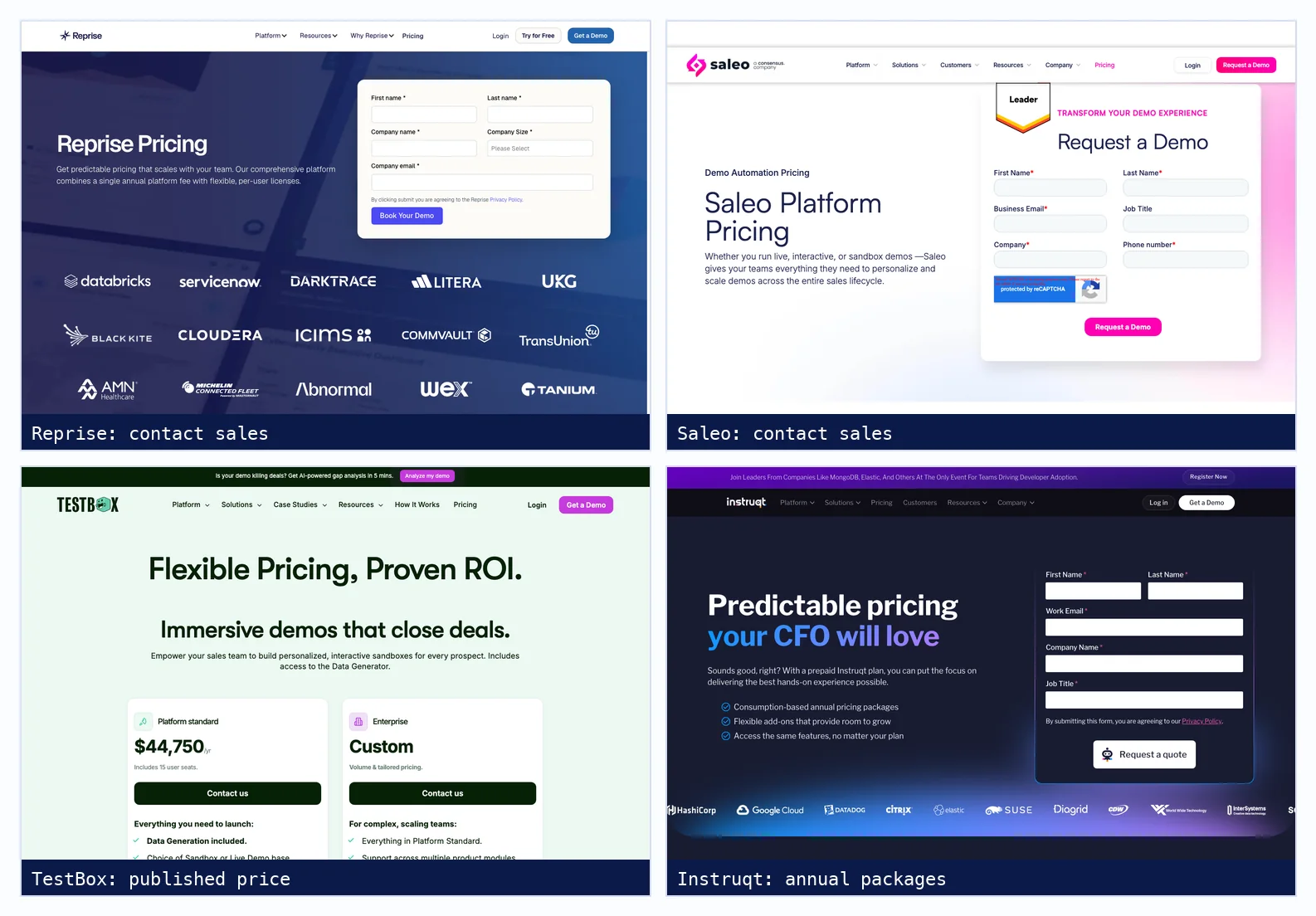
We compared ten tools from their own websites and pricing pages on 3 October 2026. Four publish prices: TestBox, Walnut, Navattic and Storylane. The other six are priced on request. All prices below are in US dollars as shown.
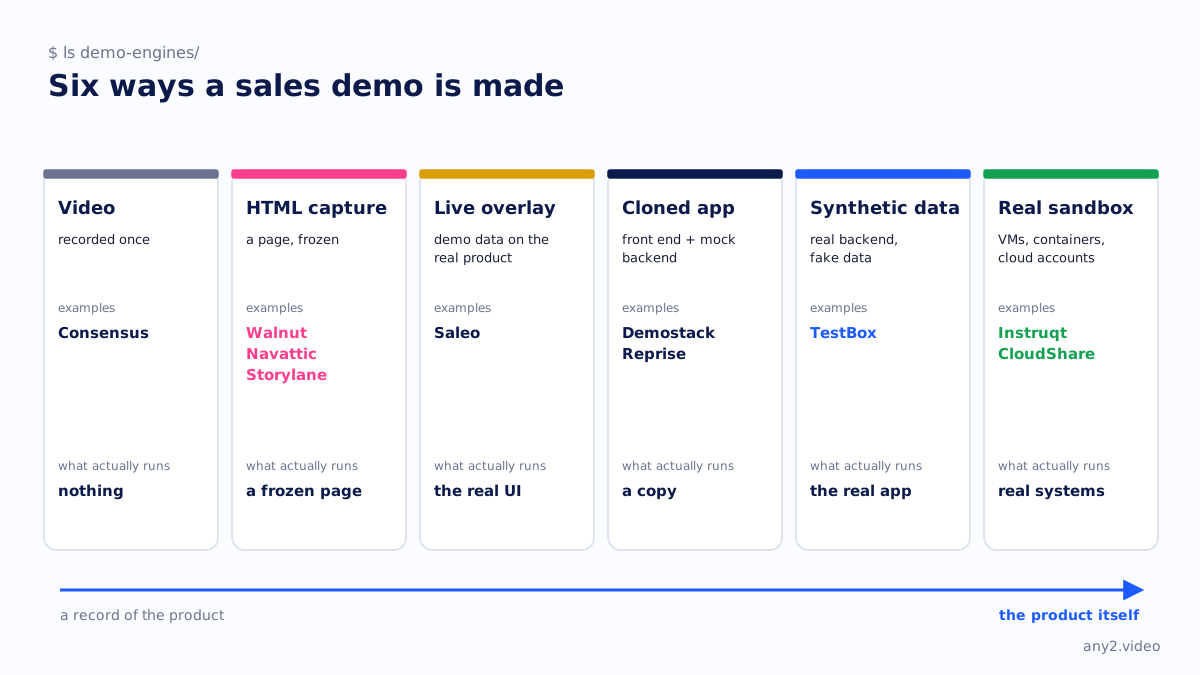
Sales demo software at a glance
| Tool | How the demo is made | Personalization | Price (3 Oct 2026) |
|---|---|---|---|
| Reprise | Cloned app, data injection on the live product, captured tours | AI datasets, variables, global find and replace | Contact sales; platform fee plus per-user licences |
| Demostack | Cloned front end with simulated backend responses | One-click swap of data, names and variables | Contact sales |
| Saleo | Demo data injected into the real, native product | Token manager, chart and table designers, data agent | Contact sales |
| TestBox | Your real backend running on AI-generated synthetic data | Surface Editor renames names, industries and terms everywhere | $44,750 a year including 15 seats; extra users $1,200 a year |
| CloudShare | Cloud-hosted replica lab environments from templates | Tailor the environment itself | Contact sales; flat rate, unlimited users |
| Instruqt | Real sandboxes: VMs, containers, Kubernetes, cloud accounts | Tailor the scenario itself | Contact sales; annual packages by hours used |
| Walnut | HTML capture, then AI builds and personalizes | AI changes logo, data and terms; CRM fields on Accelerate | Ignite $575 a month, Accelerate $1,550 a month, billed annually |
| Navattic | HTML capture with a Chrome extension | Variables, routed share links, AI data edits | Free Starter; Base $500 a month annually or $600 monthly |
| Storylane | Screenshot and video demos; HTML from Growth | Tokens, lead-form and URL personalization from Growth | Free plan; Starter $40 a month yearly or $50 monthly |
| Consensus | Video demos, tours and live data injection | Buyers choose their path; rep sees who watched | Contact sales; per-user licences |
What is a demo environment?
A demo environment is a copy or instance of a software product set up only for demonstrations, with realistic data that cannot leak a real customer's information and that can be reset after each call. It ranges from a cloned front end that only looks like the product, through the real application running on synthetic data, to a full sandbox of virtual machines a prospect can use themselves.
What is a sandbox demo?
A sandbox demo gives the prospect their own working copy of the product to use, rather than watching a rep. Instruqt provisions real virtual machines, containers, Kubernetes clusters and cloud accounts per session; CloudShare spins up replica lab environments; TestBox runs your real backend on synthetic data per buyer. Interactive demo platforms such as Navattic and Storylane also sell sandbox-style demos on their higher plans.
The three kinds, briefly
Demo environments: Reprise, Demostack, Saleo, TestBox, CloudShare, Instruqt
These keep a running product, or a convincing copy of one, ready for a sales engineer. Saleo overlays demo data on the real product, so the rep demos the live interface. Demostack and Reprise clone the application; Demostack's own FAQ says it costs more than many demo tools. TestBox runs the real backend on synthetic data and is the only one of the six with a published price. CloudShare and Instruqt provide real infrastructure, which suits installable and developer software.
Interactive demo platforms: Walnut, Navattic, Storylane
These capture the product's interface as HTML or screenshots and let a buyer click through it without a rep. They are faster to build and easier to share than an environment, and nothing behind them runs. Navattic and Storylane both have free plans; Walnut starts at $575 a month on annual billing. Our interactive demo software comparison covers them in depth.
Video demo automation: Consensus
Consensus builds demos from recordings, tours and live data, and lets each stakeholder choose the parts relevant to them while the rep sees who watched and who it was shared with. It suits complex deals with many people involved, where the first demo is watched rather than given.
How do you personalize a sales demo?
Most tools swap names, logos and data per prospect from a template. Reprise, Demostack, Saleo and TestBox let a rep change company names, industry terms and datasets across a whole demo at once; Walnut and Storylane fill tokens from CRM records, lead forms or URL parameters; Navattic routes visitors to different demo paths by interest. Personalization changes what the demo says, not what it proves.
What is a reverse demo?
The term has two meanings in use. Storylane's definition is a prospect-led exploration, where the buyer takes control of the product to discover its value themselves. Others use it for the opposite order: the buyer first shows their own current process, and the seller demonstrates against that. Both put the prospect's task first. All the definitions we found are from vendor or consultant blogs.
Which sales demo software should you choose?
Choose by what the buyer needs to believe. If a click-through is enough, an interactive demo platform is the cheapest and fastest. If the rep must show the real interface live, a data overlay such as Saleo. If the buyer must see real backend behaviour, TestBox. If they must run commands or install something, Instruqt or CloudShare. For async demos to many stakeholders, Consensus.
Where a recorded walkthrough fits
Every tool here is built for a live or interactive moment in the deal. Before that moment, and after it, buyers look for proof they can check without a rep: the task run on the real product, the version shown, the attempt that failed kept in. That is a verified walkthrough, like the Proxmox VE 9.2 install in our library. Our pages on product tour software and software demo video examples cover the neighbouring formats.
Sources, all fetched 3 October 2026: Reprise, Demostack, Saleo, TestBox, CloudShare, Instruqt, Walnut, Navattic, Storylane, Consensus, and Storylane on reverse demos.
Want the proof that comes before the live demo: your task, run on the real product, recorded and checked? Send it to us. The first sample is free.
$ get-sample →