
TBC mischief 1: What a 2.5 Cent Clip Means for Product Video
TBC mischief 1 is an image to video model built on Wan 2.2 and sold on fal and OpenRouter from half a cent per second. Here is what a clip costs, what the listings say it is for, and where it fits in product video.
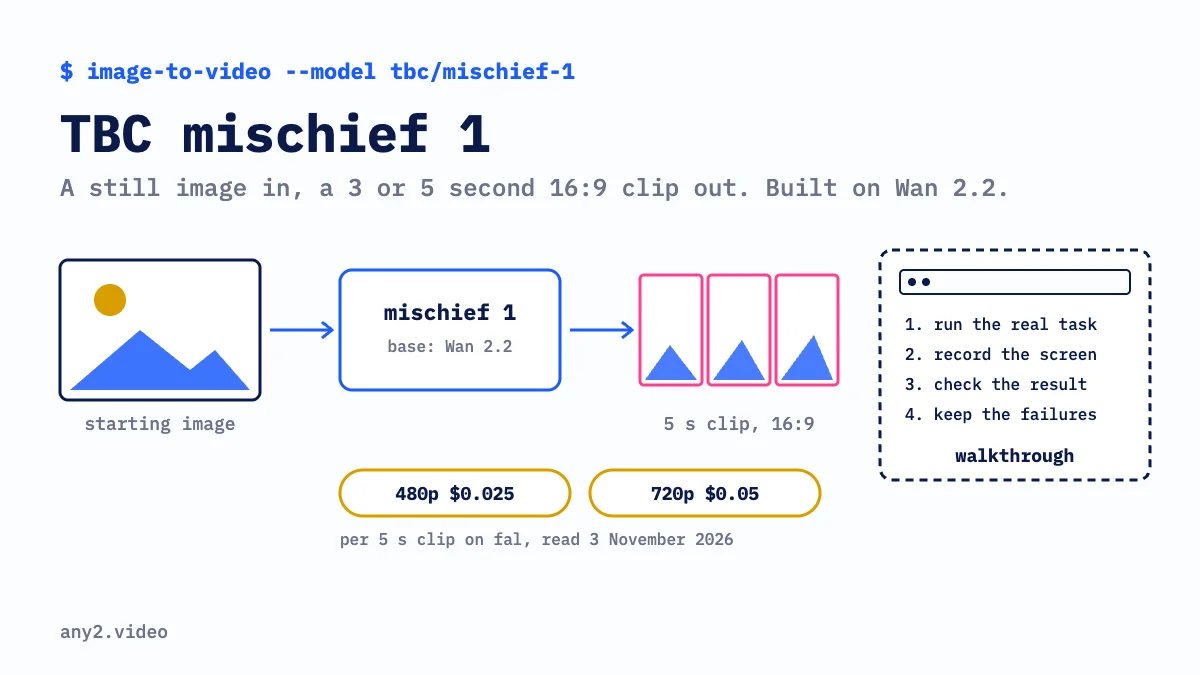
TBC mischief 1 is an image to video model from The Biological Computing Co. (TBC), announced on 30 October 2026. It is built on Wan 2.2 and runs on fal and OpenRouter, where fal lists a five second clip at $0.025 at 480p. For software teams it is a cheap way to animate stills and test ideas. It cannot show your product working.
What TBC mischief 1 is
TBC's press release, dated San Francisco, 30 October 2026, calls mischief 1 the first publicly available neuron-derived AI video model. HPCwire's AIwire ran the same release on 2 November 2026. You give it a starting image and a prompt, and it returns a short video.
The release says the model is built on Wan 2.2, which it describes as a widely used open-weight video model, and that mischief 1 matches Wan 2.2's quality while generating video 5x faster. These are TBC's own figures. The Next Web, reporting the launch on 30 October, noted that the company has not published independent tests to back up the speed claim.
The neuron part happens in TBC's lab. According to the release, TBC grows living neurons, measures how they process information, and turns what it finds into proprietary software that makes existing models more efficient. The neurons stay in the lab. Customers get software that runs on standard AI hardware and adds less than 0.1% to the base model's parameter count.
What a clip costs on fal and OpenRouter
Prices below are as shown on each listing when we read it on 3 November 2026. Check the listing before you budget, because marketplace prices change.
fal's pricing panel for mischief 1 bills per second of video generated: $0.005 per second at 480p and $0.01 per second at 720p. fal gives the worked example itself. A five second clip costs $0.025 at 480p or $0.05 at 720p.
OpenRouter lists the model from $0.005 per second and shows a five second 480p example output at $0.025. Its page says the model is served by one provider, Ambient. OpenRouter's benchmark section, run on one shared prompt, ranks mischief 1 first of 27 video models on cost and first of 27 on speed. The same section shows no quality rubric yet, so that ranking says nothing about how good the output looks.
TBC's release says mischief 1 is the lowest-priced image to video model on both marketplaces. OpenRouter's cost rank supports that for OpenRouter. We did not compare every model on fal, so on fal it is TBC's claim.
What the listings say it does, and what they leave out
OpenRouter's page lists two resolutions, 480p (854x480) and 720p (1280x720), clip lengths of 3 or 5 seconds, and one aspect ratio, 16:9. fal's form takes a starting image in common formats such as jpg, png and webp, with a resolution and a duration setting.
OpenRouter's description says the model is ideal for ideation, previsualization, moodboarding and variant testing. That is a fair summary of what a five second, 720p, 16:9 clip is good for in a software company's video work:
- Testing several versions of an opening shot before anyone films or edits the real thing.
- Giving a still, such as a product photo, a hardware shot or a hero illustration, a few seconds of motion for a storyboard.
- Showing a director, an agency or your own team the mood you want, in moving form.
The same specs set the limits. There is no 9:16 option on the OpenRouter listing, so vertical social cuts need another tool or a crop. Five seconds is the longest clip. Neither listing mentions audio. And because the model is built on Wan 2.2 and TBC says it matches that quality, newer or larger models may still look better for a finished brand film. We have not tested the output ourselves, so we make no quality claim beyond what TBC and the listings state.
Where a verified walkthrough still matters
A product walkthrough has to show a buyer that a real task works in the real product: the menu path, the settings, the result on screen. An image to video model generates every frame from a starting picture and a prompt. If you feed it a screenshot of your app, any movement in the interface is the model's guess, and a buyer who later tries the same steps can find they do not match.
Length is the other gap. A walkthrough of one task usually runs longer than a minute, and it has to stay continuous and correct from start to finish. Twelve separate five second clips at fal's 720p rate would cost $0.60, but they would be twelve unconnected shots with no task performed in any of them.
In practice, use a cheap generator for the shots around the product, such as openings, transitions and mood pieces, and record the product itself for the part that proves it works. AI video generators for product marketing covers the same limits for other generators, and our Pika H3 Flex article looks at another model launched the same week.
Where any2.video fits
any2.video makes verified product walkthroughs. An operator runs a real task on the real product, checks the result against evidence the product produced, and keeps the failed attempts in the record. Our pricing page lists $6 to $15 per finished minute depending on the mode, and the first sample, one product and one task, is free.
A mischief 1 opening and a recorded walkthrough can sit in the same video. What a verified walkthrough proves lists the questions to ask any video vendor, us included.
Questions about TBC mischief 1
What is TBC mischief 1?
An image to video model from The Biological Computing Co., announced on 30 October 2026. It is built on Wan 2.2. TBC says efficiencies found in lab-grown neurons make it 5x faster than Wan 2.2 at the same quality; no independent test of that has been published.
How much does TBC mischief 1 cost?
On fal, read on 3 November 2026: $0.005 per second at 480p and $0.01 per second at 720p, so $0.025 or $0.05 for a five second clip. OpenRouter lists it from $0.005 per second.
Is mischief 1 the cheapest image to video model?
TBC says it is the lowest priced on fal and OpenRouter. OpenRouter's own benchmark ranks it first of 27 on cost. We did not check every model on fal.
Is TBC mischief 1 based on Wan 2.2?
Yes. TBC's release says it is built on Wan 2.2, the open-weight video model, and adds TBC's own software, which the release says is less than 0.1% of the base model's parameter count.
Does mischief 1 use real brain cells to make videos?
No. According to TBC, the neurons stay in its lab and are used for research. The model you call on fal or OpenRouter runs on standard AI hardware.
Can I use TBC mischief 1 for a software demo video?
For short shots around the demo, yes: openings, transitions, a moving product still. For the part that shows your software doing a task, record the real product. Clips top out at five seconds and any interface the model animates is generated.
Sources, all read on 3 November 2026: The Biological Computing Co., press release, 30 October 2026, HPCwire AIwire, The Biological Computing Co. Brings Neuron-Derived AI Video Model to Market (2 November 2026), fal, Mischief 1 image to video model page, OpenRouter, TBC: mischief 1 model page, The Next Web, TBC launches Mischief, an AI video model shaped by brain cells (30 October 2026).
Use a cheap generator for the shots around your product. For the part that has to prove the product works, send one product and one task. The first sample is free.
$ get-sample →