
Pika H3 Flex: What It Changes for Product Videos
Pika H3 Flex is an open-weight video and audio model Pika launched on 29 October 2026. It drafts fast from up to 12 references. Here is what it does, what it costs on Pika's API, and where it fits in product video.
Pika H3 Flex is an open-weight video and audio model that Pika launched on 29 October 2026. Pika's launch release says it was post-trained on MiniMax H3 for professional iteration: you make quick drafts, then finish the take you want. For teams making product videos, it gives a faster way to test ideas around a product, though it cannot record or operate your software.
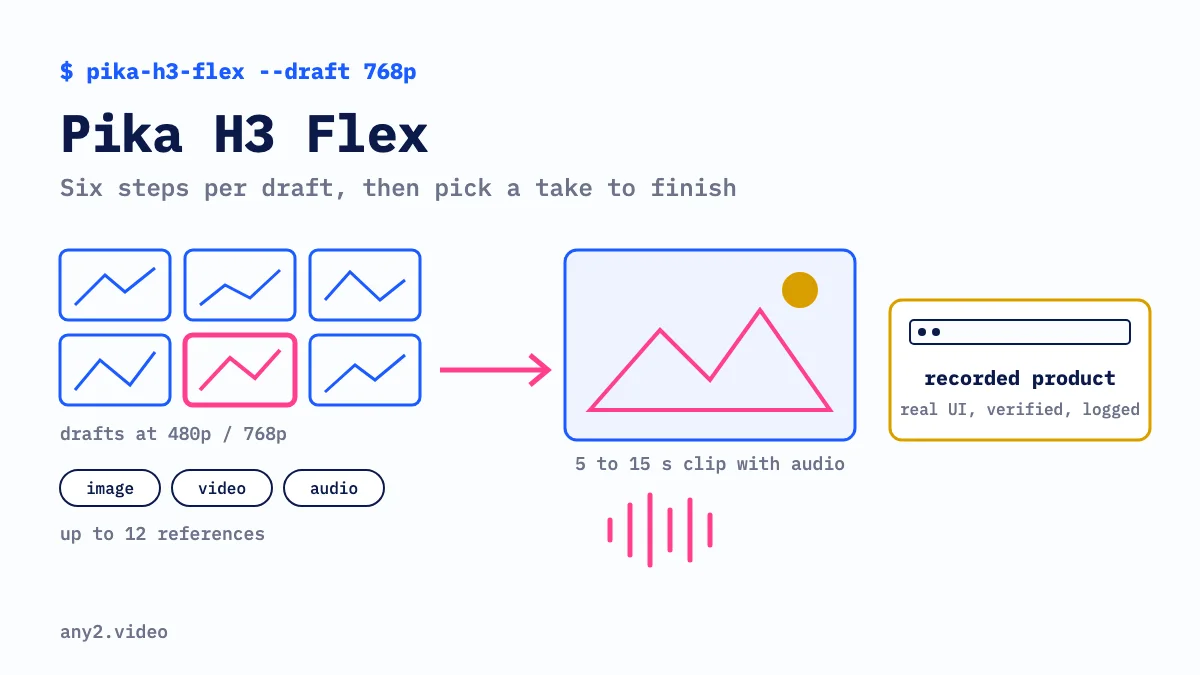
What Pika H3 Flex is
Pika's Hugging Face model card says H3 Flex generates video with synchronized audio in six sampling steps and accepts up to 12 reference inputs. In the Business Wire release, Pika research lead Cade Li says the team brought generation down from 50 steps to six. The Hugging Face page lists the model size as 33B parameters.
The weights are on Hugging Face and the inference code is on GitHub. The model card also links ComfyUI workflows and Hugging Face Diffusers support.
What runs locally and what stays on Pika's API
The model card says local inference with the open weights gives native 480p or 768p video with mixed stereo audio. Clips are requested at 5 to 15 seconds, at 24 fps, in one of 11 aspect ratios that include 16:9 and 9:16.
Pika's product page says the 1080p, 2K and 4K upscaler, the separate audio stems and prompt enhancement are hosted features. So if you self-host, you get the drafts and the mixed audio. The finishing pass goes through Pika.
Self-hosting needs a large GPU. The GitHub README says representative cases were tested on one H100 80GB GPU per request. The model card says the bundled base components take about 210 GB. The weights ship under the MiniMax H3 Community License Agreement, so read it before you use the output commercially.
Speed and price
Pika's release says Flex can generate a 15-second 768p clip with audio in as little as seven seconds. Pika's own page adds that this is transformer compute time in a controlled benchmark, and that a real request takes longer.
Pika's H3 Flex page lists prices per output second. At 480p the regular price is $0.02 and the launch price is $0.01. At 768p it is $0.04, or $0.02 at launch. At 4K it is $0.16, or $0.08 at launch. When you use a video as a reference, the same page says input video seconds are charged too. Image and audio references are free.
The same page offers Pika API Club members 15 free generations a day from 29 October to 5 November 2026. The Business Wire release says Flex comes to Pika's own creation app on pika.art starting 2 November 2026.
What it changes for product and demo videos
Cheap, fast drafts change how you plan the parts of a video that sit around the product. You can try several openings, transitions or b-roll directions at 768p and only pay to finish the one the team picks.
References help keep things consistent. Pika's page lists a product photo, a character sheet, a moodboard and a voice sample as possible inputs, and it names product films among the genres Flex targets. That helps when the same device or mascot has to look the same across a series of short clips.
Audio comes with every clip. Through the API you can also pull dialogue, score, effects, Foley and ambience as separate WAV files, according to Pika's page. That makes it easier to drop the music under your own narration.
Open weights mean you can run drafts on your own GPUs. For a company with unreleased product images, that can be the deciding point, as long as it has the hardware the README describes.
Pika's own documentation sets the limits. A clip runs 15 seconds at most. Native output is 768p. The model card notes that its showcase clips cannot be guaranteed to reproduce with the released package. A tool built for exploring is less suited to a shot you need to recreate exactly after the next release.
Where a verified walkthrough still needs more
A product walkthrough shows a buyer that a real task works in the real product: the menu path, the settings, the result. A generated clip creates every pixel, so any interface in it is made up. Flex can supply the opening shot or a product film around your demo. The demo itself has to be recorded from the product.
Walkthroughs also run longer than 15 seconds and go stale when the interface changes. Keeping product videos current after each release covers that problem.
Where any2.video fits
any2.video makes verified product walkthroughs. An operator runs a real task on the real product, checks the result against evidence the product produced, and keeps the failed attempts in the record. Delivery takes about two days. Our pricing page lists $6 to $15 per finished minute depending on the mode, and the first sample, one product and one task, is free.
The two can work together in one video. AI video generators for product marketing covers the same limits for other generators, and what a verified walkthrough proves lists the questions to ask any vendor, us included.
Questions about Pika H3 Flex
What is Pika H3 Flex?
A video and audio generation model from Pika, launched on 29 October 2026. Pika post-trained it on MiniMax H3 so it drafts in six steps, takes up to 12 references and generates synchronized sound with each clip.
Is Pika H3 Flex open source?
The weights are open. They are on Hugging Face under the MiniMax H3 Community License Agreement, and the inference code is on GitHub. Pika's page says the 4K upscaler and audio stems stay on its hosted API.
How much does Pika H3 Flex cost?
Pika's H3 Flex page lists text and image generation from $0.02 per output second at 480p, with a launch price of $0.01. Higher resolutions cost more, and video references add input seconds. Running the open weights yourself costs your own GPU time.
Can Pika H3 Flex make 4K video?
Through Pika's API, yes. The model generates at 480p or 768p, and Pika's hosted upscaler finishes a chosen clip at 1080p, 2K or 4K. Local inference stops at 768p, according to the model card.
How long can a Pika H3 Flex clip be?
Between 5 and 15 seconds per generation, according to the model card. A 15-second clip can hold several shots with hard cuts, Pika's page says.
Can I use Pika H3 Flex for a product demo video?
For the shots around the demo, it can help: openings, product films, transitions. For the part that shows your software working, record the real product, because a generated interface is invented.
Sources, all read on 30 October 2026: Pika, Pika Launches Pika H3 Flex, a Video Model Built for Professional Iteration (Business Wire via FinancialContent, 29 October 2026), Pika, Pika H3 Flex product page, Pika-Labs/Pika-H3-Flex model card on Hugging Face, Pika-Labs/Pika-H3-Flex on GitHub, VP Land, Pika H3 Flex Is a New Open-Weight Video Model Built for Fast Iteration (29 October 2026).
Use Pika H3 Flex for drafts and b-roll if it suits your brand. For the part that has to prove your product works, send one product and one task. The first sample is free.
$ get-sample →