AI Video Generator Pricing, October 2026: Dreamina at $0.29, VideoGen's Ten-Minute Model, and the Cost That Did Not Fall
Dreamina is selling a first month of Seedance 2.5 for $0.29 and VideoGen has announced a ten-minute model with $1 million in free credits. The footage was never the expensive part of a software demo video; proving the task works on a stated version still is.
AI video generator pricing moved again this week. Dreamina, the CapCut tool from ByteDance, is selling the first month of its Basic plan in the United States for $0.29, with Seedance 2.5 included. VideoGen, a Y Combinator-backed company in San Francisco, announced a model that plans and renders videos up to ten minutes long and opened a $1 million pool of free credits. For a software company that makes demo videos, the short answer: the price of footage fell, and the price of proof did not move.
What Dreamina's pages say about the $0.29 month
Dreamina's pricing page, read on 25 October 2026, shows a 98% discount on Seedance 2.0 and 2.5: $0.29 for the first month of a qualifying recurring monthly membership, ending 30 October. Its Seedance 2.5 pricing page, dated 23 October 2026, adds the detail: the eligible US Basic first month costs $0.29 and includes 1,575 credits, the listed US renewal price is $15 a month, the offer started on 21 October 2026, and users who redeemed the earlier 90% offer are not eligible. The offer FAQ says the end date has not been confirmed.
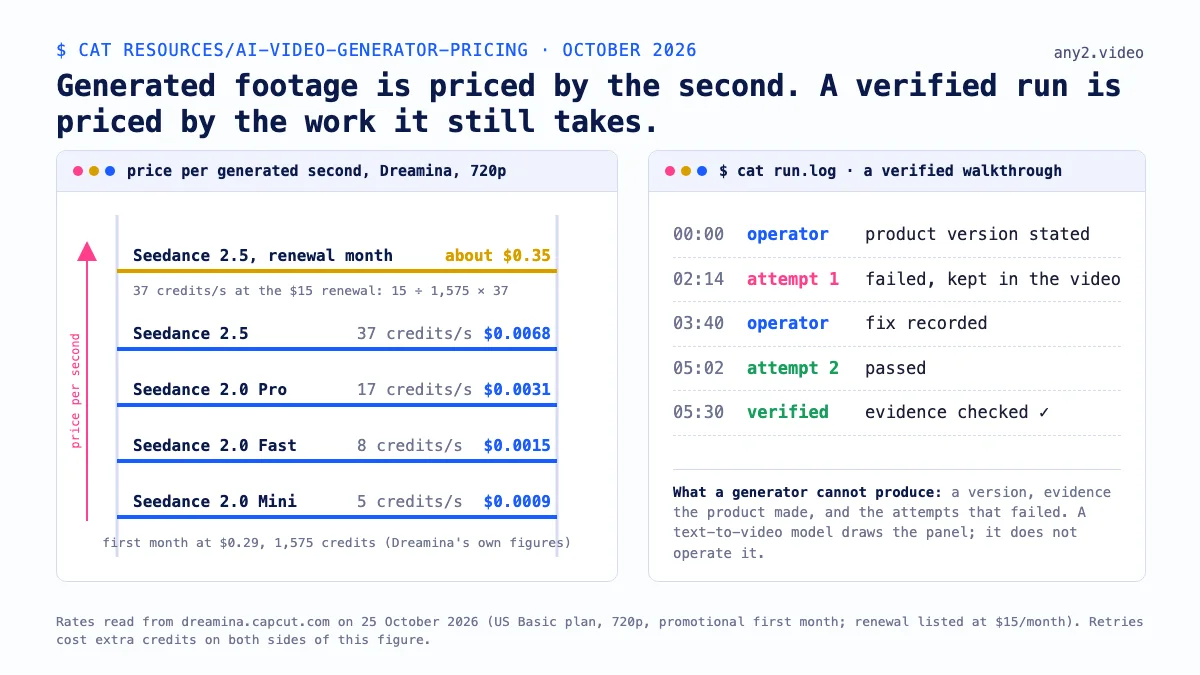
The same page lists Seedance 2.5 at 37 credits per generated second at 720p, about $0.0068 a second during the discounted month. Seedance 2.0 Pro is 17 credits a second, Fast is 8 and Mini is 5. Retries consume more credits.
Run the same arithmetic at the renewal price. $15 divided by 1,575 credits, multiplied by 37, is about 35 cents per generated second at 720p, so a renewal month covers about 42 seconds of Seedance 2.5 before any retry. Higgsfield's pricing post of 20 October 2026 estimates that a 1080p eight-second clip draws 728 credits on Dreamina's $15 Basic plan, about $6.93 a clip and roughly two clips a month, assuming every generation succeeds first time. A Reddit thread this week asked whether $0.29 is a promotion or cheaper inference; Dreamina's pages say it is an introductory payment and the renewal is $15.
What VideoGen announced
VideoGen's press release of 20 October 2026 describes Model 1 as its first video generation model: a text prompt and up to 16 reference images become a finished, multi-shot video of up to ten minutes, with the screenplay, shots and audio planned by what the company calls a thinking harness. Applications opened the same day for a $1 million pool of free credits for selected projects, to be distributed through the end of 2026. The company expects Model 1 to cost more than 50% less than comparable models, based on internal validation; final pricing and third-party validation are still underway, and the 20 October rollout is limited to private partners.
The release also says the pipeline checks its own output and retries selected renders within a set budget. Even the generator budgets for failed attempts; it keeps them out of the finished video.
What a cheap generator can do for a product walkthrough
It can illustrate. A generated server room, a hand on a keyboard or an abstract dashboard costs cents at Dreamina's introductory rate and a few dollars after renewal, which suits the parts of a software video that were never about your software:
- B-roll between screen recordings, where you used to buy stock footage or leave a slide on screen.
- Explainer sections about a problem or an architecture, before the product appears.
- Openings for a second market, regenerated with local text on screen while the recorded walkthrough stays the same.
What it cannot do
A text-to-video model does not run your product. It has no account, no licence key and no access to version 4.2 of anything. Ask it for an administrator configuring single sign-on and it draws a plausible settings panel, success message included, and nothing in the clip tells a buyer that your product did it or that it works on the version they are about to install. AI video generators for product marketing covers the same limit for Synthesia, HeyGen, Runway and Veo; it holds for Seedance and Model 1.
The footage was always the cheap part of a software demo video. The expensive part is a person, or an operator, in front of the real product, trying the task, hitting the error nobody documented, fixing it and recording the evidence that the result is real. A generator at a cent a second has made the cheap part cheaper.
How to use the price drop
A workable split for a release video:
- Generate the opening 10 to 20 seconds: the problem, the setting, the abstract diagram.
- Record the task on the real product, on a named version, with the attempts that failed left in. This is the part a buyer will check.
- Reuse the recorded run for other markets: a second language is a new narration track and captions over the same footage. Product demo video in multiple languages walks through the choices.
- Label the generated sections. A buyer who spots an unlabelled generated screen will stop trusting the recorded ones.
What to ask any vendor, including us
The three questions from what a verified walkthrough proves matter more now that footage is cheap:
- Which version did it run against? A generated clip has no version. A walkthrough states one.
- What evidence shows the task completed? A log, the resulting state on screen or a command's output, in the video.
- What happened on the attempts you did not show? If the answer is that there were none, either the task was trivial or the failures were cut.
If a vendor can answer all three, you are buying a walkthrough. If they cannot, you are buying footage, and footage now costs cents a second. Pay accordingly.
Our own answer is on the Proxmox VE 9.2 install page: version, run date, run log and the failed attempts, all published. The first sample is free: one product, one task, two days. For generators as a category, see any2.video versus AI video generators.
Sources, all read on 25 October 2026: Dreamina pricing, Dreamina Seedance 2.5 pricing, Dreamina October offer FAQ, Higgsfield on Seedance 2.5 pricing, VideoGen press release on GlobeNewswire.
Have the footage made anywhere you like. For the part that has to prove the product works, send one product and one task. The first sample is free.
$ get-sample →