The Best Marketing Videos for Software Products Are the Ones That Show a Task Finishing: 9 Worth Copying
Nine video patterns that reliably work for software companies, with what makes each one work and roughly what it costs to copy. Award winners are left out on purpose.
Part of our guide to The 12 Types of Marketing Videos Software Companies Actually Need, and the 4 That Waste the Budget.
Lists of the best marketing videos tend to be lists of the most expensive ones, and nearly all of them are brand films. They are beautiful and win awards, but they make poor models, because you cannot copy a two-hundred-thousand-dollar production and what they demonstrate is a mood more than a product.
A note on method, because it matters here. These are patterns, and we do not link to nine specific videos. Recommending named videos would mean vouching for content that can change without notice, and the useful thing to copy was always the shape of the video. You can copy any of these this quarter with the stack in video marketing tools for software companies.
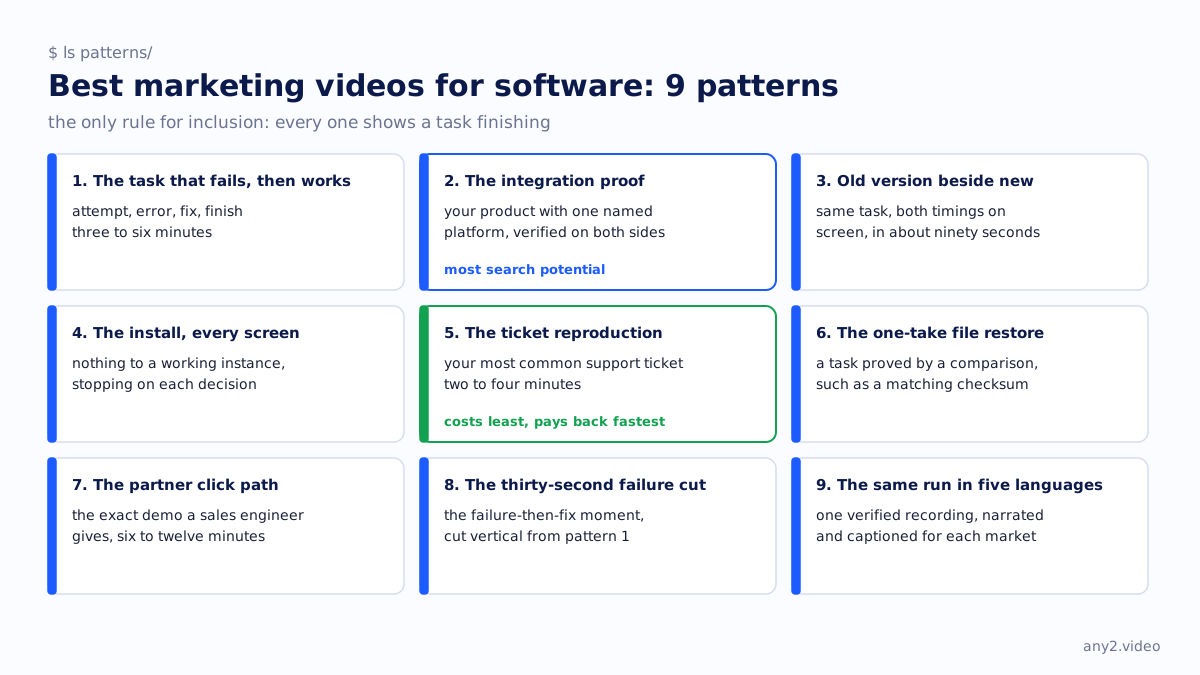
1. The task that fails, then works
Someone attempts a real job, hits an error, works out the cause, fixes it and finishes, in three to six minutes.
This format shows that someone who did not already know the answer can use the product, which no other format here does. The error string is also what people search for. It is the cheapest video on the list, because you were going to hit the error anyway and would normally delete that take.
2. The integration proof
Show your product working with one named third-party platform. State the prerequisites and verify one outcome on both sides.
No pattern on this list has more search value. Someone searching "[your product] with [their product]" knows exactly what they want, and the best current answer is usually a forum thread from three years ago. Hardly anyone makes these, because it means setting up both products for real.
3. Old version beside new
Run the same task on the previous release and the current one, side by side, with both timings on screen, in about ninety seconds.
It turns an adjective into a fact. Engineers forward "41 seconds on 3.1, 9 seconds on 3.2", and nobody forwards "dramatically faster".
4. The install, every screen
Go from nothing to a working instance and stop on each decision, including the one that erases the disk and the one everybody gets wrong.
An install video deflects a whole class of tickets and reaches people who have not bought anything yet. Our own example, the Proxmox VE 9.2 install walkthrough, documents both of those traps instead of glossing over them.
5. The ticket reproduction
Take your most common support ticket, reproduce it in a clean environment and fix it, in two to four minutes. Support owns this video, not marketing.
You measure it in deflected tickets instead of views. The demand is already visible in your queue, so this is the only pattern here with a guaranteed audience before you record.
6. The one-take file restore
This covers any task proved by a comparison: a restored file whose checksum matches the original, an exported record matching its source, or an account that matches before and after a migration.
A checksum on screen does more than a minute of narration, because the viewer can check it instead of taking your word for it.
7. The partner click path
Record the exact demo a sales engineer gives, once, so every reseller gives the same one. It runs six to twelve minutes with a one-page click path beside it.
It replaces the two-hour recorded training call that nobody watches to the end, and partner demos become consistent without anyone having to police them.
8. The thirty-second failure cut
Cut the failure-then-fix moment from the first pattern into a vertical clip for social. Never record it separately, since it should always come from an existing video.
It does well on social because something happens in it: a thing breaks and then works again. Product content rarely has a story like that.
9. The same run in five languages
Make one verified recording and narrate and caption it for each market, instead of recording five times.
The evidence is identical in all five versions, which is what you want. Partners and regional teams get the same proof without a second run, and the translations cannot drift apart.
What the nine have in common
Every pattern here shows a task finishing. That was the only rule for inclusion, and it rules out most award-winning videos.
If you are choosing where to start, the ticket reproduction costs least and pays back fastest, and the integration proof has the most search potential. The order to make them in is covered in video content strategy for software companies, and video marketing examples, annotated explains how to judge any video someone shows you.
Pick a pattern and send one task. The first sample is free.
$ get-sample →